
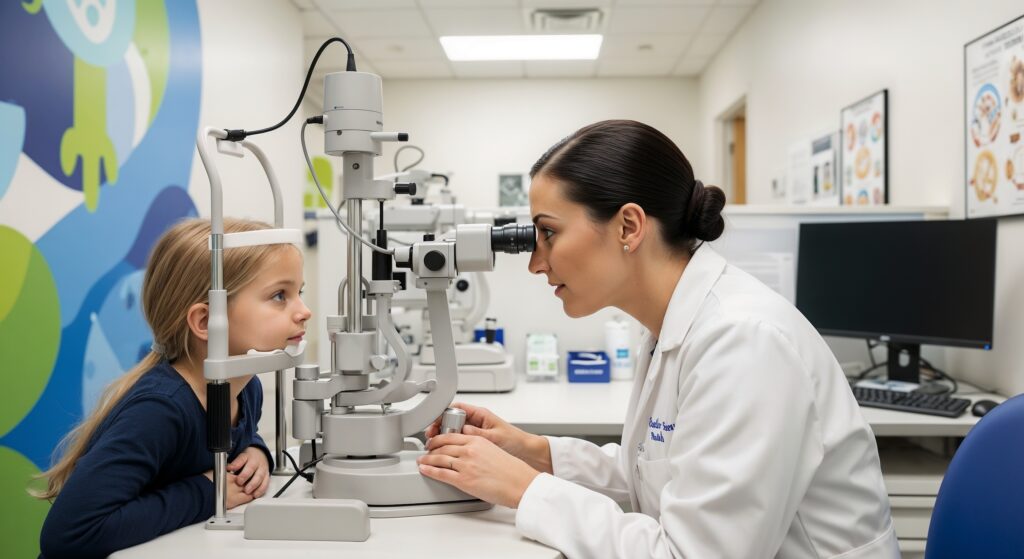
A provider-directed compounded option for children with myopia, prepared by Avrio Pharmacy in Scottsdale, Arizona
If your child has been diagnosed with myopia, their eye care provider may talk to you about low-dose atropine eye drops as part of a myopia management plan. It is a reasonable question to wonder what exactly these drops are, why they may be compounded, and what side effects your child might experience.
At Avrio Pharmacy, we compound 0.05% low dose atropine eye drops. This concentration has shown great benefit in managing childhood myopia. The decision to use this strength always comes from a licensed eye care provider, based on your child’s prescription, daily routine, and sensitivity to side effects. Our role is to expertly prepare the medication as the provider directs.
Why Compounding Exists for This Use
Atropine has been used in eye care for many years. At higher concentrations, it is commercially available as a dilation agent. However, those commercial versions, typically 1%, are far stronger than what is used for myopia management, and the side effects at those doses can affect a child’s day-to-day life. Compounding allows pharmacies to create lower dosages of the same medication for a multitude of reasons.
The research most commonly referenced for low-dose atropine in myopia is the LAMP study (Low-concentration Atropine for Myopia Progression), which examined 0.01%, 0.025%, and 0.05% concentrations compared to placebo. These three strengths are the foundation of most current low-dose atropine protocols.
Understanding Side Effects Across Low-Dose Atropine Concentrations
One of the most helpful things a parent can know is how side effects change depending on the strength of atropine being used. Typically, as the concentration goes up, both the effect on myopia progression and the intensity of side effects tend to increase.
Here is what to expect at each of the relevant concentrations, and how they compare to the higher commercial doses.
0.01% Atropine (Compounded, low-dose)
Myopia progression effect: Study data suggests 0.01% slows myopia progression compared to no treatment, though it tends to show less effect on both refractive error and axial elongation than 0.05% in the LAMP study results.
0.05% Atropine (Compounded — the strength Avrio prepares)
Myopia progression effect: In the LAMP study, 0.05% showed the strongest effect on slowing both refractive error progression and axial elongation among the low-dose concentrations studied, which is one reason many providers choose it as their preferred strength for myopia management.
Overall: The LAMP study found 0.05% to be one of the more effective low-dose options for slowing myopia progression while still maintaining reasonable tolerability. This is why many providers choose it as their preferred strength, and it is the only concentration of atropine sulfate that Avrio compounds for this purpose.
1% Atropine (Commercial dose, not used for myopia management)
Myopia progression effect: Higher concentrations do tend to slow myopia progression, but the side-effect burden (pupil dilation, near-vision blur, etc.) at these doses makes them impractical for long-term daily use in most children. This is a core reason why low-dose compounded options like 0.05% exist.
These concentrations illustrate why compounding for low-dose atropine exists. The commercially available option may be too strong for myopia management.
A Note on Nighttime Dosing Low-Dose Atropine
Most low-dose atropine protocols ask parents to give one drop in each eye at night, usually just before bedtime. This timing helps reduce how much the child notices the side effects during the school day, since the biggest changes in pupil size and near vision happen while the child is resting or asleep.
For families using 0.05% atropine, nighttime dosing, combined with sunglasses outdoors during the day, can make the drops much easier to manage in everyday life.
Less Common and Rare Side Effects With Low-Dose Atropine
Across all concentrations of atropine eye drops, there is a chance of systemic effects if enough of the medication is absorbed beyond the eye. These can include dry mouth, mild flushing, slight changes in heart rate, headache, or in rare cases difficulty urinating.
These effects tend to be uncommon with low-dose ophthalmic use, but they are worth knowing about.
Serious systemic reactions are extremely rare, but any unusual or persistent symptom should be discussed with the prescribing provider right away.
When To Contact Your Eye Doctor
Reach out to the prescribing eye care provider if:
- Side effects are persistent or getting worse over time
- The drops are affecting school, reading, or daily activities
- Your child seems unusually bothered by the drops or resistant to using them
Seek urgent medical attention if your child develops severe light sensitivity, sudden significant vision changes, signs of an allergic reaction such as swelling or hives, difficulty breathing, rapid heartbeat, confusion, or inability to urinate.**
How Compounding Supports Your Eye Doctor’s Plan
Atropine 0.05% ophthalmic drop is not commercially available in the United States, which is where compounding pharmacies, like Avrio, fill that void. A licensed provider, who wants this specific strength for a patient, needs a compounding pharmacy to prepare it.
All of these decisions are guided by the licensed provider. Avrio’s role is to prepare the compounded 0.05% atropine exactly as prescribed, not to decide what approach is best for an individual child. That clinical judgment belongs to the eye care provider.
For Providers: How to Send a Prescription
Avrio Pharmacy works directly with licensed eye care providers and accepts prescriptions through several channels:
Electronically to Avrio Pharmacy
Fax: 480-270-6701
Phone: 480-270-6700
Hard copy submitted directly to the pharmacy, by the patient
Shipping is available in licensed states. Pickup is available at our location in Scottsdale, Arizona.
Sources
Disclaimer
This content is for informational purposes only and is not a substitute for professional medical advice. Compounded medications are prepared pursuant to a valid prescription from a licensed healthcare provider. Dosage, administration, and suitability depend on the patient’s specific condition, size, and health status. Always consult with a licensed provider before starting, stopping, or changing any treatment. Avrio Pharmacy provides compounded 0.05% atropine eye drops only with a valid prescription. Compounded medications are not FDA approved and are not tested for safety, quality, and efficacy.
** Avrio Pharmacy is not a clinical provider. For any questions about your child’s symptoms or treatment, please contact the prescribing provider directly.